The Couple Space journal
Bare Minimum in a Relationship: 9 Signs You’re Settling for Less in 2026
In this article

You text them good news and get back, “nice.”
You plan the calls. You suggest the dates. You ask the deeper questions. You notice when the energy shifts. You try to keep the connection alive, and somehow you are still wondering if you are asking for too much.
That is what makes the bare minimum in a relationship so confusing: it does not always look like a dramatic breakup-worthy disaster. Your partner might not be cruel. They might not be cheating. They might even say they care.
But if their effort is so low that you constantly feel lonely, unseen, or responsible for keeping the relationship alive, something is off.
The bare minimum is not about one late reply, one busy week, or one awkward conversation. It is about a pattern: one person keeps showing up, while the other does just enough to keep the relationship from ending.
This guide breaks down what bare minimum effort actually looks like, what healthy baseline effort looks like instead, and what to do if you feel like you are carrying the relationship alone.
What Is the Bare Minimum in a Relationship?
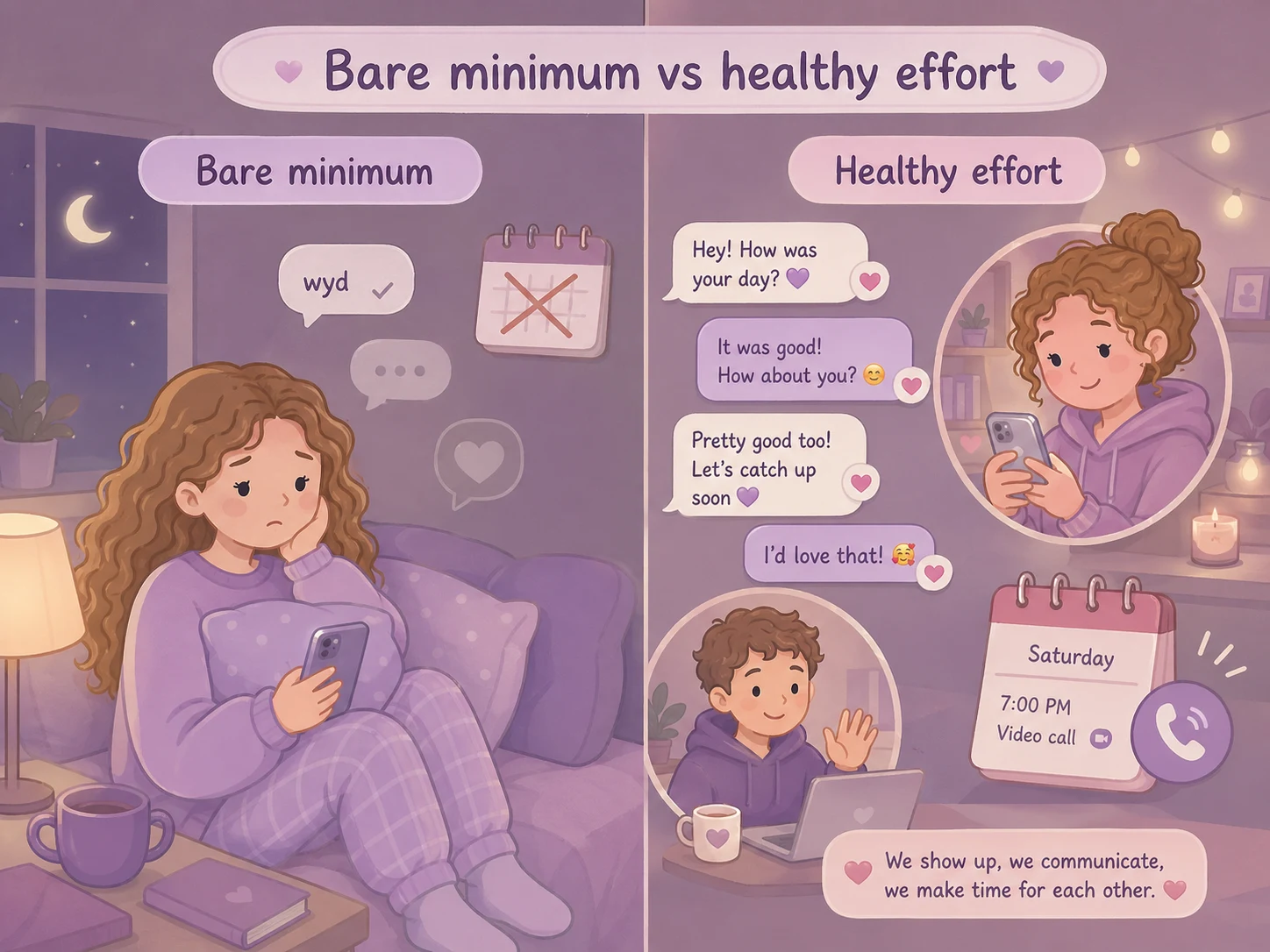
The bare minimum in a relationship is when someone does just enough to keep the relationship technically alive, but not enough to make it feel mutual, emotionally safe, or genuinely connected.
It can look like:
replying, but not really engaging
saying they care, but rarely showing it
agreeing to plans, but never making them
apologizing, but not changing
enjoying the benefits of the relationship, but not investing in it
A healthy relationship does not require constant attention or grand romantic gestures. People get busy. Energy changes. Real life is not a movie.
But healthy relationships do require mutual effort. Research on relationship maintenance points to behaviors like positivity, openness, assurances, social support, and sharing tasks as ways couples sustain connection over time. Healthy relationships are also commonly built on respect, trust, honesty, emotional support, open communication, equality, understanding, and care.
So the question is not, “Does my partner perform perfectly every day?”
The better question is:
Do I feel like we are both trying, or do I feel like I am keeping this relationship alive by myself?
In a long-distance relationship, bare minimum effort can feel even sharper. If you do not share everyday life in the same place, your calls, texts, rituals, and follow-through become part of how the relationship exists. When those are inconsistent or empty, distance can start feeling like emotional distance too.
9 Signs You’re Getting the Bare Minimum in a Relationship
1. You’re Always the One Initiating
You text first. You ask when they are free. You suggest the call. You plan the date. You bring up the conversation about where things are going.
If you stopped initiating, the relationship would go quiet.
That is one of the clearest signs of bare minimum effort: the relationship depends on your momentum. They may respond when you reach out, but they rarely create connection on their own.
In early-stage dating, this can look like someone acting interested in person but never making plans unless you push. In a long-distance relationship, it can look like you always doing the time zone math, always asking when they can call, always adjusting your schedule around theirs.
Healthy effort does not have to be exactly 50/50 every day. Some weeks, one person will naturally have more capacity than the other. But over time, the relationship should not depend on one person constantly pulling it forward.
Healthy effort looks like:
they start conversations too
they suggest plans
they check in without being prompted
they remember important things
they help make the relationship feel active, not just available
A partner who cares does not need to be chased into basic participation.
2. Their Communication Is Technically There, but Emotionally Empty
They reply. Technically.
But the replies are “wyd,” “lol,” “cool,” “busy,” “yeah,” or “nice” with no follow-up, no curiosity, and no real emotional presence.
This is where people start doubting themselves. You think, “They are texting me, so maybe I’m being dramatic.” But communication is not just the existence of messages. It is whether those messages create connection.
Good communication does not need to be constant. You do not need paragraph texts all day. But you should feel some level of interest, responsiveness, and care.
In long-distance relationships, this matters even more. Research on long-distance texting found that more frequent and responsive texting predicted greater relationship satisfaction among long-distance participants. That does not mean every couple needs to text all day. It means that when distance is part of the relationship, responsive communication can carry emotional weight.
Bare minimum communication sounds like:
“wyd” every night, but no real conversation
no questions about your day
changing the subject when you share something emotional
leaving you to carry every deeper topic
replying only when convenient, with no effort to reconnect later
Healthy communication sounds like:
“How did that thing go today?”
“I’m tired tonight, but I still want to hear about your day tomorrow.”
“I can’t call long, but I wanted to check in.”
“Tell me more.”
“I remembered what you said yesterday.”
Presence is not about perfect texting. It is about making the other person feel like they matter.
3. Plans Only Happen When They’re Convenient for Them
A low-effort partner may like seeing you, but only when it requires almost nothing from them.
Calls happen when they are bored. Dates happen near them. Visits stay vague. They cancel but do not reschedule. You rearrange your life, and they “see how they feel.”
This is not the same as someone having a demanding schedule. Busy people can still be intentional. A caring partner may not always be available, but they will usually make an effort to create clarity.
Bare minimum planning sounds like:
“Maybe next week.”
“We’ll see.”
“I forgot.”
“I’m tired.”
“Why are you making it a big deal?”
Healthy planning sounds like:
“I can’t tonight, but I can call Friday.”
“Let’s pick a date now so we don’t keep missing each other.”
“I know I cancelled. I want to make it up to you.”
“This month is busy, but I still want us to have time.”
In an LDR, vague planning can be especially painful. If visits, calls, and shared routines are always uncertain, the relationship can start to feel like waiting for someone who never fully arrives.
4. They Like Having You, but They Don’t Really Show Up for You
Some people like the comfort of a relationship more than the responsibility of one.
They like affection when it is easy. They like having someone to text. They like knowing you are there. They like the label, the attention, the emotional safety net.
But when you need support, curiosity, consistency, or effort, they disappear into vagueness.
This is the difference between enjoying a relationship and investing in it.
Bare minimum looks like:
they want comfort from you, but rarely offer it back
they like being cared for, but do not ask how you are
they enjoy the relationship when it is easy, but avoid it when it requires effort
they say they care, but your experience says otherwise
Healthy effort looks like mutual care. Not perfect care. Not mind-reading. Not constant emotional availability. But a real attempt to be there for each other.
Relationship satisfaction is shaped by both individual and relationship-level dynamics, including perceived partner commitment, appreciation, conflict frequency, and other relational factors. In plain language: how your partner shows up matters.
A relationship should not feel like emotional convenience for one person and emotional labor for the other.
5. You Feel Lonely Even When You’re Together
One of the most painful signs of bare minimum effort is feeling alone while technically being in a relationship.
You may spend time together, but not feel close. You may talk every day, but only about logistics. You may sit next to each other, but both be on your phones. You may be long-distance and “in contact,” but still feel unknown.
Loneliness inside a relationship can be confusing because outsiders may see you as coupled. But emotionally, you feel like you are waiting to be noticed.
Research on loneliness and romantic relationship well-being has found loneliness to be associated with lower relationship well-being. And phone distraction can make this worse: partner phubbing, or ignoring a romantic partner in favor of a phone, has been negatively associated with relationship satisfaction.
Bare minimum presence looks like:
being physically together but emotionally unavailable
scrolling through the whole date
talking often but never deeply
never asking follow-up questions
treating time together like background noise
Healthy presence looks like attention.
Not constant eye contact. Not a perfectly deep conversation every night. Just moments where you feel chosen, heard, and included.
Presence is not access. Presence is attention.
6. They Avoid Real Conversations About the Relationship
Every time you try to talk about the relationship, they shut it down.
You ask where things are going, and they say, “Why do we have to label everything?” You ask for more consistency, and they say, “You’re overthinking.” You bring up something that hurt you, and they act like the conversation itself is the problem.
Bare minimum effort avoids clarity because clarity requires responsibility.
In a healthy relationship, not every serious conversation will be easy. Some people need time to process. Some people get nervous during conflict. Some people are still learning how to talk about feelings.
But a caring partner does not punish you for wanting clarity.
Healthy effort sounds like:
“I need a little time to think, but I do want to talk about this.”
“I didn’t realize that was affecting you that much.”
“I’m not great at these conversations, but I’m listening.”
“Let’s figure out what would feel better for both of us.”
Love Is Respect notes that unmet expectations are often a reason to check in, not assume your partner can read your mind; it also emphasizes that clear communication about wants, needs, boundaries, and expectations helps partners get on the same page.
If you cannot talk about the relationship without being dismissed, the problem is not that you want too much. The problem is that the relationship has no safe place to be honest.
7. They Make You Feel Needy for Wanting Basic Effort
There is a difference between needing constant reassurance and needing basic consistency.
Wanting a call is not automatically clingy. Wanting a plan is not automatically pressure. Wanting emotional support is not automatically drama. Wanting your partner to ask about your life is not asking for a luxury service.
Bare minimum partners often make reasonable needs sound unreasonable because it protects them from having to change.
This can sound like:
“You need too much.”
“You’re too sensitive.”
“Why can’t you just chill?”
“I already text you.”
“Nothing is ever enough for you.”
The healthy baseline is not constant attention. It is consistent care.
A healthy partner can still have boundaries. They can say, “I cannot text all day,” or “I need alone time,” or “I can call tomorrow, not tonight.” But they should not make you feel ashamed for wanting a relationship that feels mutual.
Basic effort includes:
respect
honest communication
follow-through
emotional presence
repair after conflict
some shared planning
interest in each other’s lives
That is not neediness. That is relationship.
8. They Apologize, but Nothing Changes
“I’m sorry.”
“I’ll do better.”
“I know, I’ve been busy.”
“You’re right.”
For one day, maybe two, things improve. They text more. They act affectionate. They promise they understand. Then the pattern returns.
An apology without behavior change can become another form of bare minimum effort: just enough emotional reassurance to keep you from leaving, but not enough follow-through to repair the actual issue.
Healthy repair includes:
naming what happened
understanding why it hurt
taking responsibility
changing the pattern
staying consistent after the conflict calms down
No one changes perfectly overnight. But there should be some visible movement.
If the same conversation keeps happening with different wording, pay attention. The pattern may be giving you more information than the apology.
9. The Relationship Depends on Your Hope More Than Their Effort
This is the sign people often do not want to admit.
You are not staying because the relationship feels good now. You are staying because of what it was at the beginning, what they promised, or what you believe they could become.
You keep thinking:
“They were so different at first.”
“They have potential.”
“Maybe after this stressful month, it will change.”
“They said they care.”
“I know they can be better.”
Hope is not bad. Relationships need hope. But hope cannot be the only thing holding the relationship together.
A healthy relationship usually becomes clearer over time. Not perfect, but clearer. You understand each other more. You build trust. You see patterns of care.
A bare minimum relationship often becomes more confusing over time. You keep trying to decode mixed signals, defend their potential, and survive on small moments of affection.
If you are more attached to who they could be than how they actually treat you, it may be time to look at the pattern instead of the promise.
Situation | Bare minimum | Healthy baseline | Strong relationship effort |
|---|---|---|---|
Texting | “wyd” with no real follow-up | Checks in and responds with interest | Remembers details, asks questions, and makes you feel included in their day |
Planning time together | Only sees you when it is convenient | Makes time when possible and communicates clearly | Helps create routines, dates, calls, or visits you both look forward to |
Emotional support | Changes the subject or gives flat replies | Listens and tries to understand | Follows up later and remembers what matters to you |
Conflict | Says “sorry” to end the conversation | Takes responsibility and talks respectfully | Works with you to prevent the same pattern from repeating |
LDR calls | Calls only when bored or available last minute | Plans calls with basic consistency | Protects shared time and creates rituals between calls |
Future planning | Keeps everything vague | Can talk honestly about expectations | Makes plans that match the level of commitment |
Affection | Affection only when they want comfort | Shows warmth in ways that feel mutual | Notices your needs and expresses care without being prompted every time |
Accountability | Promises change but repeats the pattern | Makes visible effort after feedback | Stays consistent even after the conflict has passed |
What You Actually Deserve in a Relationship
You do not need a partner who performs romance like a movie.
You do not need someone who texts every minute, reads your mind, cancels their whole life for you, or never has a bad day.
But you do deserve a relationship with a healthy baseline.
That baseline includes:
respect
honesty
emotional safety
consistency
mutual effort
curiosity
clarity
support
accountability
willingness to repair
The National Domestic Violence Hotline describes healthy relationships as communicative, respectful, trusting, and honest. Healthdirect similarly lists respect, honesty, trust, open communication, equality, understanding, care, and emotional support as common signs of healthy relationships.
A healthy relationship does not mean you never feel disappointed. It means you can talk about disappointment without being punished for having needs.
It does not mean every moment feels intense. It means care is consistent enough that you are not starving for proof.
It does not mean effort is always equal in every tiny moment. It means the relationship does not run on one person’s energy alone.
Why People Settle for Bare Minimum Effort
People do not usually settle because they are foolish. They settle because relationships are emotional, attachment is powerful, and mixed signals can be genuinely confusing.
Here are some common reasons people accept less than they need.
Fear of being alone
Research on fear of being single found that it predicts settling for less in romantic relationships. That does not mean everyone who stays is afraid of being single. But it does mean fear can make “not enough” feel safer than starting over.
The beginning was better
Low-effort relationships often start with intensity. At first, they may text constantly, make plans, compliment you, and seem emotionally available. When the effort drops, you keep comparing the present to the beginning.
You are not imagining that they were different. But the current pattern still matters.
You confuse potential with pattern
Potential is what someone could do. Pattern is what they repeatedly do.
A relationship cannot be built on potential alone.
You have low expectations from past relationships
If you have been ignored, dismissed, or made to feel “too much” before, basic inconsistency can start to feel normal. Sometimes the bare minimum feels like an upgrade because the past was worse.
But “better than before” is not the same as healthy.
Digital communication has normalized emotional crumbs
Modern dating can make low effort look normal: delayed replies, vague plans, half-attention, endless “wyd” loops, and people who want intimacy without consistency.
But common does not always mean acceptable.
Long-distance anxiety makes you over-function
In a long-distance relationship, it is easy to feel like if you stop trying, the whole thing will fade. So you plan more, ask more, wait more, forgive more.
But distance cannot be carried by one person. It needs shared rituals, shared effort, and shared responsibility.
What Happens When You Keep Accepting the Bare Minimum
Bare minimum effort does not always break your heart all at once. Sometimes it slowly trains you to need less.
You stop asking for calls. You stop sharing good news. You stop bringing up hurt feelings because you already know the conversation will go nowhere. You become “chill,” but really you are becoming quiet.
Over time, accepting the bare minimum can lead to:
resentment
relationship anxiety
emotional exhaustion
lower self-worth
loneliness inside the relationship
over-functioning
losing touch with your own needs
confusing crumbs for care
feeling grateful for effort that should have been normal
In long-distance relationships, the cost can look like:
distance feeling more emotional than physical
calls becoming obligations
visits carrying too much pressure
one person doing all the planning
the relationship becoming more about waiting than connecting
The saddest part is not always that the relationship ends. Sometimes the sad part is how much of yourself you shrink to keep it going.
What to Do If You’re Getting the Bare Minimum
1. Name the Pattern Clearly
Do not start with “You don’t care about me.”
Start with the pattern.
For example:
“I’m usually the one initiating our calls.”
“When I share something important, you rarely ask follow-up questions.”
“We say we’re serious, but we do not make actual plans.”
“When you cancel, you usually do not reschedule.”
“I feel like our connection depends on me starting everything.”
Naming the pattern keeps the conversation grounded. It also helps you see whether your partner responds with curiosity or defensiveness.
2. Decide What Your Baseline Needs Are
Before asking for “more effort,” define what more effort actually means.
Your baseline might be:
one intentional check-in per day
one weekly date or call
clearer visit plans if you are long-distance
more emotional follow-up
less phone distraction during time together
more shared decision-making
a real conversation about where the relationship is going
Be specific. “Try harder” is easy to agree to and hard to measure. “Can we plan one call every Sunday?” is clearer.
3. Have One Direct Conversation
You do not need to beg. You do not need to write a speech. You do need to be clear.
Try:
“I don’t need constant attention, but I do need this relationship to feel mutual. Lately I feel like I’m the one initiating most of our connection, and I need to know whether you’re willing to work on that with me.”
Or:
“When I bring something up and it gets dismissed, I feel alone in the relationship. I want us to be able to talk about needs without it turning into me being ‘too much.’”
For LDR:
“Distance is already hard. I need us to have some kind of rhythm, because waiting around for random texts and vague calls is making me feel disconnected.”
The goal is not to force them to become someone else. The goal is to see whether they are willing to meet you in the relationship.
4. Watch Behavior, Not Just Reassurance
After the conversation, listen to what they say. Then watch what they do.
Healthy signs include:
they initiate more
they follow through
they ask what would help
they take responsibility without making you the villain
they help create a routine
they stay consistent after the conflict has passed
Unhealthy signs include:
they mock your needs
they make you feel guilty for asking
they improve for two days and then stop
they say all the right things but avoid action
they turn the conversation into your “insecurity”
A changed pattern matters more than a comforting promise.
5. Build Daily Connection Rituals If Both People Want to Try
If both people genuinely care and want to reconnect, small rituals are often more realistic than huge relationship overhauls.
You do not always need a dramatic “relationship reset.” Sometimes you need a repeatable way to show up.
For couples who both want to try, a daily question can be a surprisingly simple way to make effort visible. Couple Pulse is built around that kind of low-pressure ritual: one small prompt, one tiny moment of attention, one reason to check in with each other beyond “wyd.”
This is especially useful when the issue is not a lack of love, but a lack of rhythm.
In a long-distance relationship, connection cannot rely only on occasional long calls or the next visit. You need small shared moments between the bigger ones. Couple Pulse gives couples a private space for daily questions, tiny games, and simple rituals that help distance feel less empty when both partners want to keep showing up.
The important part is mutuality. An app cannot fix a relationship where only one person cares. But for two people who both want to be more consistent, small rituals can make effort easier to practice.
6. Know When It’s Not a Communication Problem
Sometimes the issue is not unclear expectations. Sometimes it is a lack of respect.
If your partner repeatedly dismisses, mocks, controls, pressures, scares, manipulates, or punishes you for having needs, this is not a “daily connection” problem. It is a safety and respect problem.
In that case, do not focus on becoming easier to love. Focus on support, boundaries, and safety. Talk to someone you trust or a qualified professional. If you feel unsafe, seek immediate help in your location.
A healthy relationship can have conflict. It should not make you feel small, afraid, or trapped.
Common Questions About the Bare Minimum in a Relationship
What is the bare minimum in a relationship?
The bare minimum in a relationship is when someone does just enough to keep the relationship going, but not enough to make it feel mutual, emotionally safe, or connected. It often looks like low effort, vague plans, empty communication, and one person carrying most of the connection.
Is texting every day the bare minimum?
Texting every day is not automatically meaningful effort. A daily “wyd” with no curiosity may still feel empty. Healthy texting is not about constant contact; it is about responsiveness, interest, and making the other person feel included.
Am I asking for too much in my relationship?
You are not asking for too much if you want respect, consistency, honest communication, emotional support, and mutual effort. You may need to clarify your expectations, but wanting basic care does not make you needy.
What does bare minimum effort look like in a long-distance relationship?
In a long-distance relationship, bare minimum effort can look like missed calls, vague visit plans, one-word replies, no shared routines, no emotional follow-up, and one person always managing the time zone math. Distance needs intentional connection, not just occasional contact.
Can a low-effort partner change?
A low-effort partner can change if they recognize the pattern, care about the impact, and follow through with consistent behavior. Reassurance alone is not change. Look for repeated action over time.
How do I ask my partner for more effort without sounding needy?
Name the pattern clearly and ask for a specific baseline. For example: “I don’t need constant attention, but I do need us to have more mutual effort. Can we plan one real check-in each day or one call each week?”
What is the difference between healthy effort and love bombing?
Healthy effort is consistent, respectful, and sustainable. Love bombing is intense, fast, and often used to create emotional dependency before consistency disappears. Healthy effort makes you feel safe over time, not overwhelmed at the beginning and confused later.
Should I leave if I’m getting the bare minimum?
Not always immediately. First, identify the pattern, clarify your needs, and have one direct conversation if it feels safe to do so. Then watch behavior. If your partner dismisses you, refuses to change, or the relationship keeps making you feel lonely and small, it may be time to reconsider whether it is healthy for you.
What are examples of basic relationship needs?
Basic relationship needs include respect, honesty, consistency, emotional support, communication, affection, accountability, clarity, and mutual effort. These are not luxury standards. They are part of a healthy baseline.
How can couples build more daily connection?
Start small. Try one daily question, one intentional check-in, one phone-free moment, one weekly call, or one tiny ritual that both people actually agree to. Not every effort has to be big. The point is to make connection repeatable.
Final Thoughts: You’re Not Asking for Too Much
The bare minimum can be hard to spot because it often comes wrapped in almost enough.
They text, but barely. They apologize, but rarely change. They say they care, but you still feel alone. They like having you, but they do not really help build the relationship.
You are not asking for too much by wanting consistency, attention, clarity, and care.
Healthy connection is built through small, repeated effort. Not constant performance. Not dramatic gestures. Just two people choosing to show up in ways the other person can actually feel.
Not every relationship effort has to be public or dramatic. Sometimes the healthiest sign is private consistency: asking, answering, remembering, checking in.
That is the space Couple Pulse is designed for: no feeds, no noise, just small ways to keep showing up for each other.
If you both want to make connection feel easier, Couple Pulse gives you a simple daily ritual to start with.